
Child Advocacy Center is safe place for abused children
by Jerry Grillo
White County News
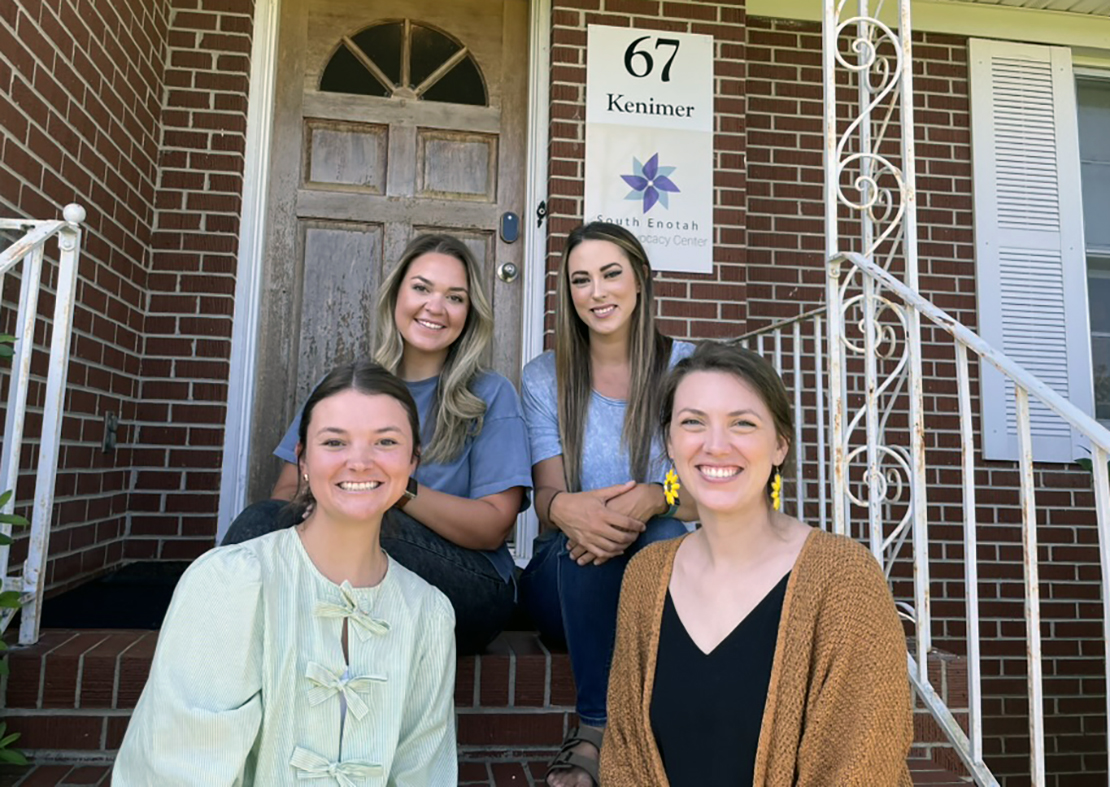
Behind the door of a pleasant house made of bricks on top of a green hill just outside of downtown Cleveland, there is a sanctuary of hope for abused children.
The South Enotah Child Advocacy Center (CAC) provides a safe, compassionate environment where young victims begin their journey toward healing. With a team of dedicated professionals, the center offers forensic interviews, medical exams, therapy, and family support services.
“Our focus is entirely on the child and the family,” says Rebekah Perethian, CAC’s executive director. “We’re here to help them through the healing process.”
The center’s approach is both strategic and deeply empathetic. When child abuse is reported, it lands with law enforcement, or the Department of Family and Children Services (DFCS), and the child, or the child and family, is referred to CAC, “and we provide a forensic interview,” explains Megan Holcombe, family advocate.
Forensic interviewer Kristen Jarrard describes a delicate approach to interviewing children, a process that often begins with what she calls “narrative practice” — asking kids to describe familiar events like dance lessons in vivid detail, building a level of comfort in talking. From there, Jarrard asks open-ended questions, using age-appropriate language, steering clear of leading questions.
“We want to create a safe space for children to share their story at their own pace,” she says. “Ideally, we get it all done in a single interview because we’d like to avoid talking further about a traumatic event.”
Jarrard has interviewed children as young as two and as old as 18, always prioritizing the child’s comfort and emotional safety. The interview rooms are carefully designed with soft colors, fidget toys, and drawing materials to help children feel at ease.
“Sometimes we’ll have kids draw out a room or a detail to help them communicate,” Holcombe says. “Sometimes, that’s easier for them.”
The interview room also has two cameras and a microphone. In another room, a member of DFCS and law enforcement — preferably both — can watch the interview remotely.
Partners in Caring
The center serves White and Lumpkin Counties, handling hundreds of cases annually. According to Carlyn Hearn, a family advocate, sexual abuse cases traditionally dominate the center’s work, but the COVID-19 pandemic saw a significant shift toward physical abuse cases.
“When everyone was stuck at home during lockdowns, we saw 36 interviews in just 30 days,” Hearn says. “And the great majority were physical abuse cases.”
The center operates through a complex network of beneficial partnerships, including local law enforcement, DFCS, the local school systems, Family Connection. Turning Points Counseling provides therapy services for CAC clients. And Mountain Education provides the building at virtually no cost.
CAC’s multidisciplinary approach extends beyond immediate intervention. The center offers a parenting support program, helping families develop healthier communication and life skills.
“A lot of what we see is generational,” says Holcombe. “Parents are often repeating patterns they learned from their own parents. We help them break those cycles.”
The center depends on government grants and community support to fulfill its critical mission. CAC hosts an annual golf tournament and Christmas gala to raise funds.
“We want to ensure that the price of therapy isn’t a hindrance,” says Holcombe who, like all the other three women who comprise CAC’s full-time staff, splits her time between Cleveland and Dahlonega, where the organization recently opened another office. “Now our Lumpkin County clients can receive services close to home.”
These could easily be considered necessary services, because the numbers are alarming: one in three girls and one in four boys will be sexually abused before their 18th birthday; 90% of children know their abuser; more than 60% of victims won’t disclose the abuse they suffered until adulthood.
The Cleveland facility looks like a peaceful country home. It’s a building where many tears have been shed. But the women who work there strive to facilitate satisfying conclusions to hard stories. And occasionally, the tears are for joy.
“Those are the moments that make this work rewarding,” says Perethian. “When we see a family healing, when we see a child finding hope — well, that’s why we do this work.”